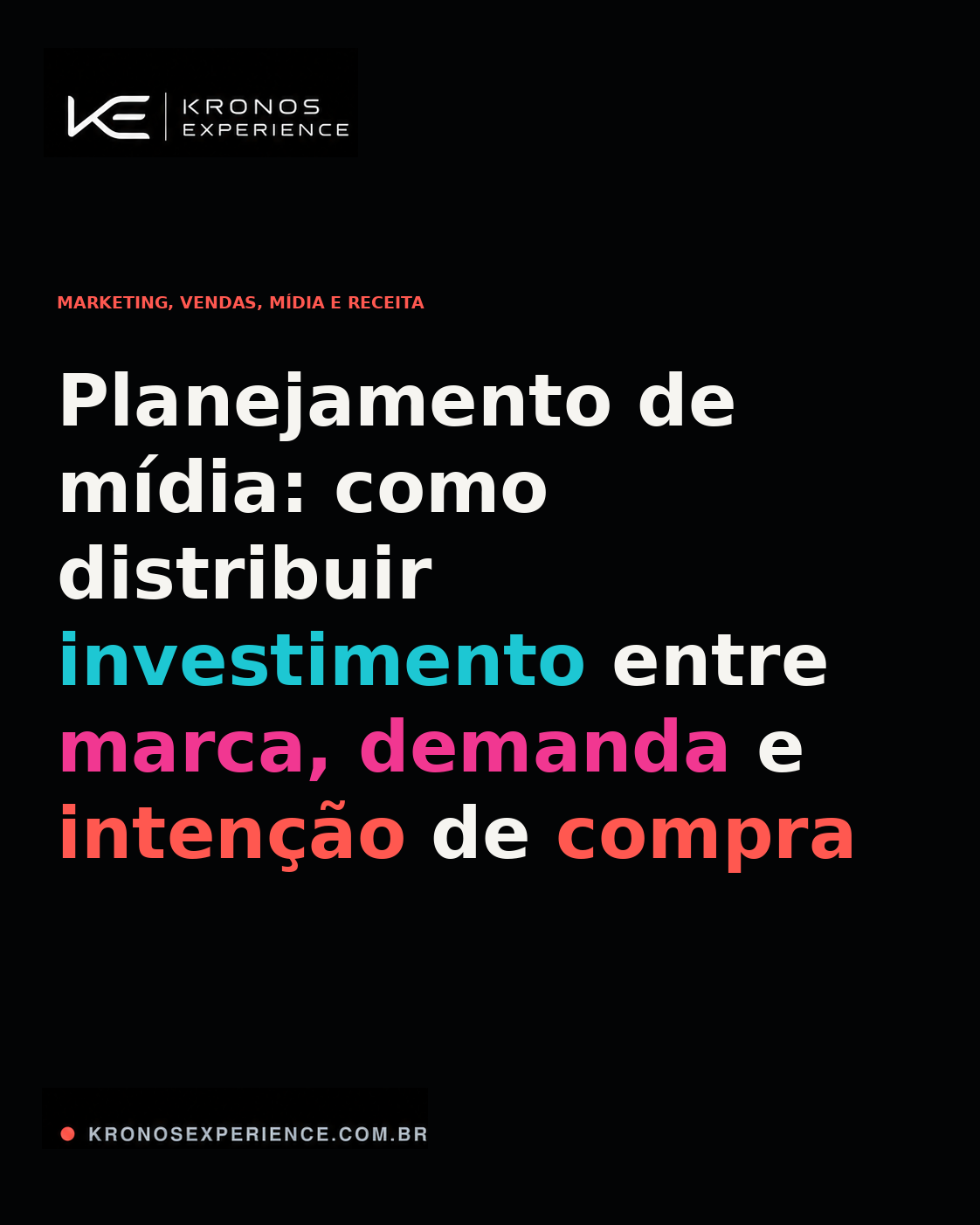
Paid media planning: how to allocate investment across brand, demand and purchase
Luís Paravato
Media planning organizes audiences, messages, channels, and investment to meet communication and business objectives. It defines the role of each initiative and how its results will be tracked.
Brand building, demand development, and purchase intent serve different functions. One campaign introduces the company to future buyers; another explores a topic in depth; another addresses a search for a provider.
Investment allocation needs to account for these functions and your company's circumstances. Your offer, market size, sales capacity, buying timeline, and delivery quality all inform the plan.
Set the objective before choosing the channel
The plan starts with the audience and the situation the communication is intended to address. A new offer requires a different explanation than a familiar product. A segment with few buyers calls for a different approach than a broad market.
Define the change the campaign seeks: increasing brand awareness, presenting a use case, encouraging research, or generating sales inquiries. Then select channels and formats suited to that purpose.
A single channel can support different objectives. A campaign's function depends on its message, audience, format, and the next step offered to the user.
Three functions of investment
| Function | Communication task | Measurement |
|---|---|---|
| Brand building | Introduce the company and its value proposition to selected audiences. | Qualified reach, frequency, and perception surveys when available. |
| Demand development | Explain needs, use cases, and alternatives. | Content consumption, interactions, and account progression over time. |
| Purchase intent | Address searches and inquiries close to a purchase decision. | Qualification, inquiry handling, opportunities, and contracts. |
Metrics need to reflect the initiative's function. A brand introduction campaign should carry different expectations for immediate results than an initiative targeting requests for proposals.
How to allocate the budget
There is no universal percentage for each function. The company considers brand awareness, search volume, offer differentiation, and the timeline for results.
Part of the investment supports initiatives with established performance. Another part funds tests with defined hypotheses and limits. The plan documents what will be evaluated, for how long, and which conditions justify expanding, adjusting, or ending the initiative.
The financial analysis accounts for investment in paid media, creative, pages, tools, and inquiry handling. The capacity to absorb demand needs to keep pace with campaigns.
Messaging and landing pages are part of the plan
The campaign sets an expectation that the landing page must meet. The audience, topic, offer, and next step need to be clear.
A call to action for an assessment needs to explain what is included and how the inquiry will be handled. Content promotion should describe the material offered. Differences between the ad and the page undermine understanding and inquiry quality.
Creative variations are based on identifiable hypotheses: the argument, use case, supporting evidence, or format. Changing several elements at once makes it harder to understand the reason for an observed difference.
The relationship between paid media, content, and sales
Content answers questions that arise in campaigns and sales discussions. The sales team reports which messages attract well-matched buyers and which create expectations beyond the offer.
The CRM retains source and context when these data are available. Analysis connects campaigns to accounts, opportunities, and contracts, allowing the time needed to track the purchase process.
Organic and paid activities also work together. Specialized content receives distribution, while searches and conversations reveal topics for new publications. The plan documents each activity's function without attributing the entire purchase to the last visit.
Illustrative example: paid media for a B2B implementation service
A company concentrates investment in search ads and receives few inquiries. Analysis shows that the audience has limited understanding of the service and that some buyers first search for guidance on organizing processes.
The plan retains campaigns for terms associated with purchasing the service and adds content on preparation, scope, and responsibilities. Distribution reaches professionals in selected segments, with messages tailored to each use case.
The sales team records questions and inquiry quality. Measurement considers brand searches, content use, opportunities, and contracts. Each metric is analyzed according to the initiative's function and the buying timeframe.
The company reviews its allocation based on the full set of information, rather than interpreting low initial search volume as an absence of a market.
How to track and adjust investment
Operational analysis checks ad delivery, frequency, budget, and page functionality. Sales analysis examines inquiry quality, handling, and progression. Financial evaluation considers returns and delivery capacity.
Investment changes need a rationale tied to this information. Results from a few days or a few contracts require caution when making comparisons, especially in long buying journeys.
Tests should preserve comparable conditions whenever feasible. Record changes to pricing, the offer, and inquiry handling during the same period, since these also affect results.
Frequently asked questions
Does every campaign need to generate leads?
The objective determines the metric. Brand, content, and purchase-intent campaigns serve different purposes in the relationship with the audience.
How do you evaluate a campaign with few contracts?
Examine how opportunities mature, the absolute numbers, and sales records. Also track audience quality and the conditions under which inquiries are handled.
When should investment increase?
An increase requires evidence appropriate to the objective, acceptable economics, and capacity to serve the additional demand. The plan documents these parameters before expansion.
How does Kronos Experience contribute?
Kronos connects market, offer, acquisition, and revenue to structure paid media, messaging, and sales tracking around your company's objectives.
About Kronos Experience
Kronos Experience is a Brazilian business strategy and intelligence consultancy focused on market, customer, product, and revenue intelligence for digital and service businesses.
We work to increase your company's value to the market and its customers, turning that value into a competitive advantage. Our work connects market strategy, positioning, brand, acquisition, paid media, and sales with customer intelligence, experience, product, data, retention, and monetization.
Through assessment, strategic direction, implementation, and ongoing monitoring, we structure opportunities to increase returns on your brand, customer base, channels, products, and infrastructure, while developing new offers and revenue sources.
Written by Luís Paravato